A Complete Wedding Outfit Guide for NRI Grooms Getting Married in India
Written By Sonam Label
Getting married in India when you live abroad is one of the most joyful — and logistically challenging — things you'll ever plan. You're coordinating across time zones, flying in family members from multiple countries, and trying to keep up with a wedding itinerary that spans four to six functions over as many days. And somewhere in between the venue bookings and the catering tastings, you still need to figure out what you're actually going to wear.
For most NRI grooms, this is where the panic quietly sets in. You've been away long enough that you're not sure which designers to trust. You don't have weeks to spend visiting studios in person. And you want something that looks authentically Indian — not like a costume — while also feeling like you, a man who's spent years building a life with different cultural reference points.
This guide is for you. And by the end of it, you'll understand exactly what each function calls for, how to think about coordinating your look across the wedding calendar, and how the right bespoke design service makes all of this genuinely manageable from wherever in the world you're reading this.
How Many Outfits Does an NRI Groom Actually Need?
This is the question that comes up in nearly every consultation, and the answer is more nuanced than most people expect. Most Indian weddings — especially those planned with a proper celebration in mind — involve at least four distinct functions, each with its own dress code and mood.
The Haldi is the most relaxed: bright, playful, and deliberately casual because you're about to be covered in turmeric paste. The Mehendi is a step up — festive without being formal. The Sangeet or cocktail evening is where you have the most creative freedom and also where photographs matter enormously. And then the wedding itself demands the most formal, considered outfit of the entire week.
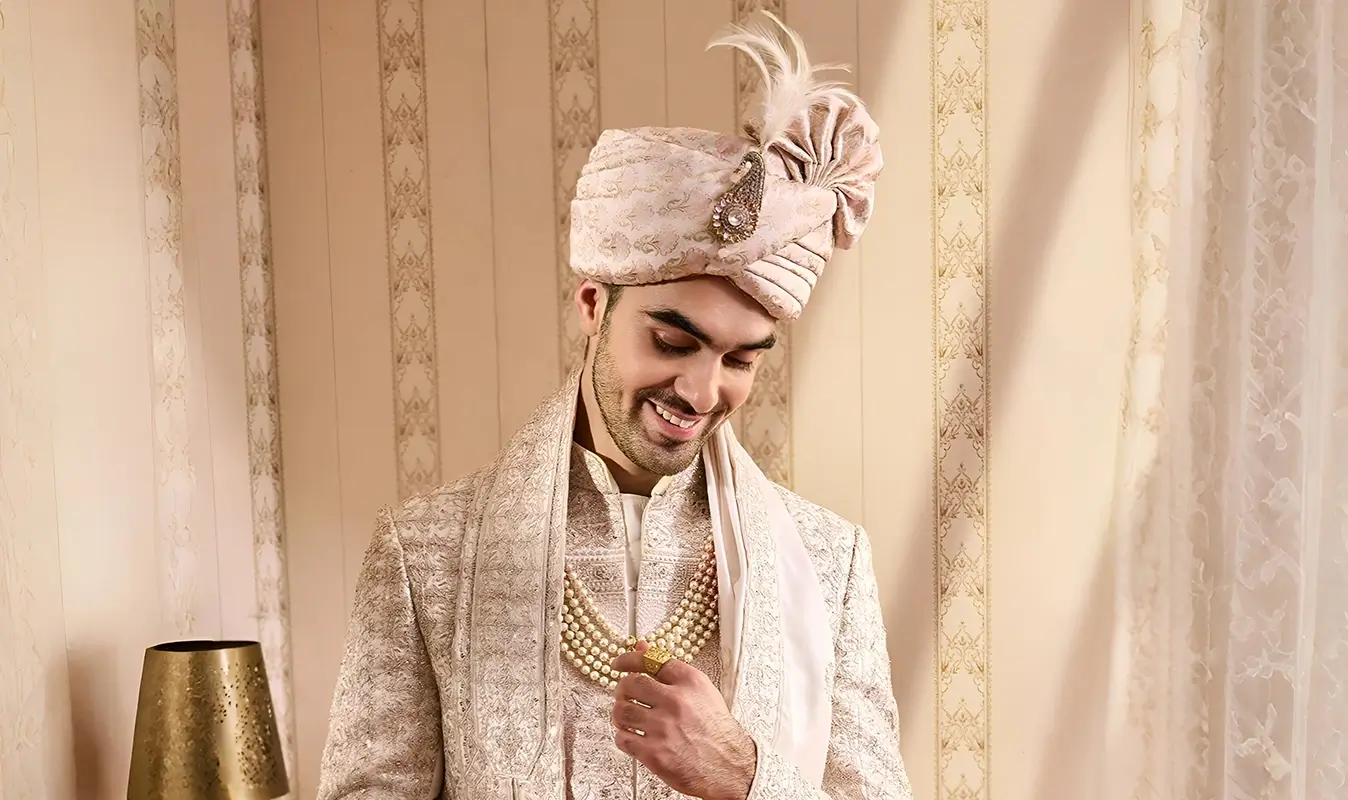
That's four distinct occasions, each requiring a different silhouette, weight of fabric, and level of embellishment. Add a reception or post-wedding brunch for many couples, and the wardrobe question becomes genuinely complex — not just for the groom, but for his immediate family, his groomsmen, and the entire travelling party coming in from abroad.
What to Wear to Each Function — A Practical Breakdown
Haldi — Keep It Light, Keep It Bright
For Haldi, the logic is simple: don't wear anything you'd be upset about ruining. But "simple" doesn't mean thoughtless. A well-fitted kurta in a bold yellow, saffron, or marigold — fabrics like cotton or linen that breathe in the heat and don't hold stains the way heavier materials do — strikes exactly the right note. It reads as intentional without being overdressed for an event that's fundamentally about joy and a little mess.
Mehendi — A Step Toward Festive
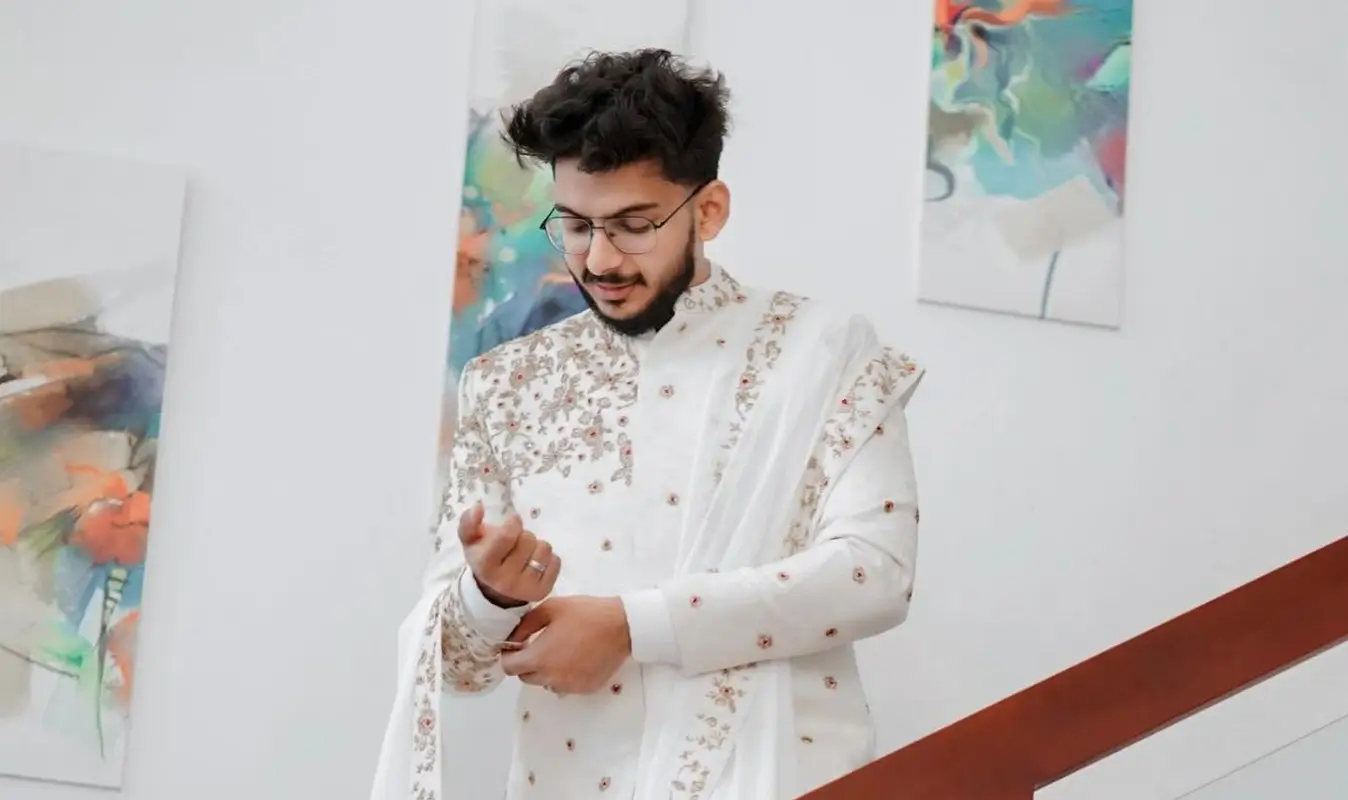
The Mehendi calls for richer colour and slightly more considered embellishment than the Haldi, but still in a register that's playful rather than regal. Deep greens, earthy terracottas, and rich blues work well for grooms. A printed or subtly embroidered kurta paired with well-fitted trousers or a dhoti pant is a combination that photographs beautifully and remains comfortable across a long afternoon.
Sangeet/Cocktail — Your Best Creative Moment
This is the function where NRI grooms consistently underestimate what's possible. The Sangeet is where Indian weddings allow for the most fashion-forward interpretation — Indo-Western silhouettes, unexpected colour combinations, structured bandhgalas in velvet or jacquard, and embellishment that catches the light on the dance floor. Don't play it safe here. The photographs from the Sangeet are often the most widely shared from any wedding.
The Wedding — Timeless, Regal, Unforgettable
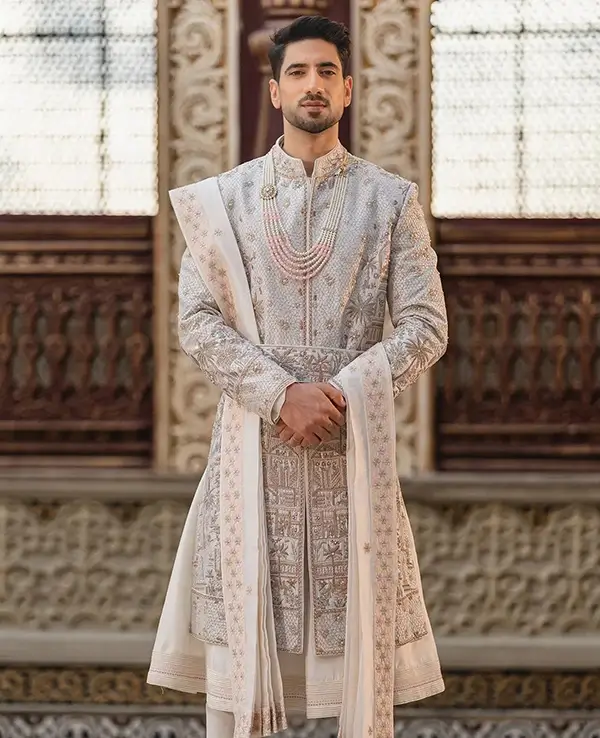
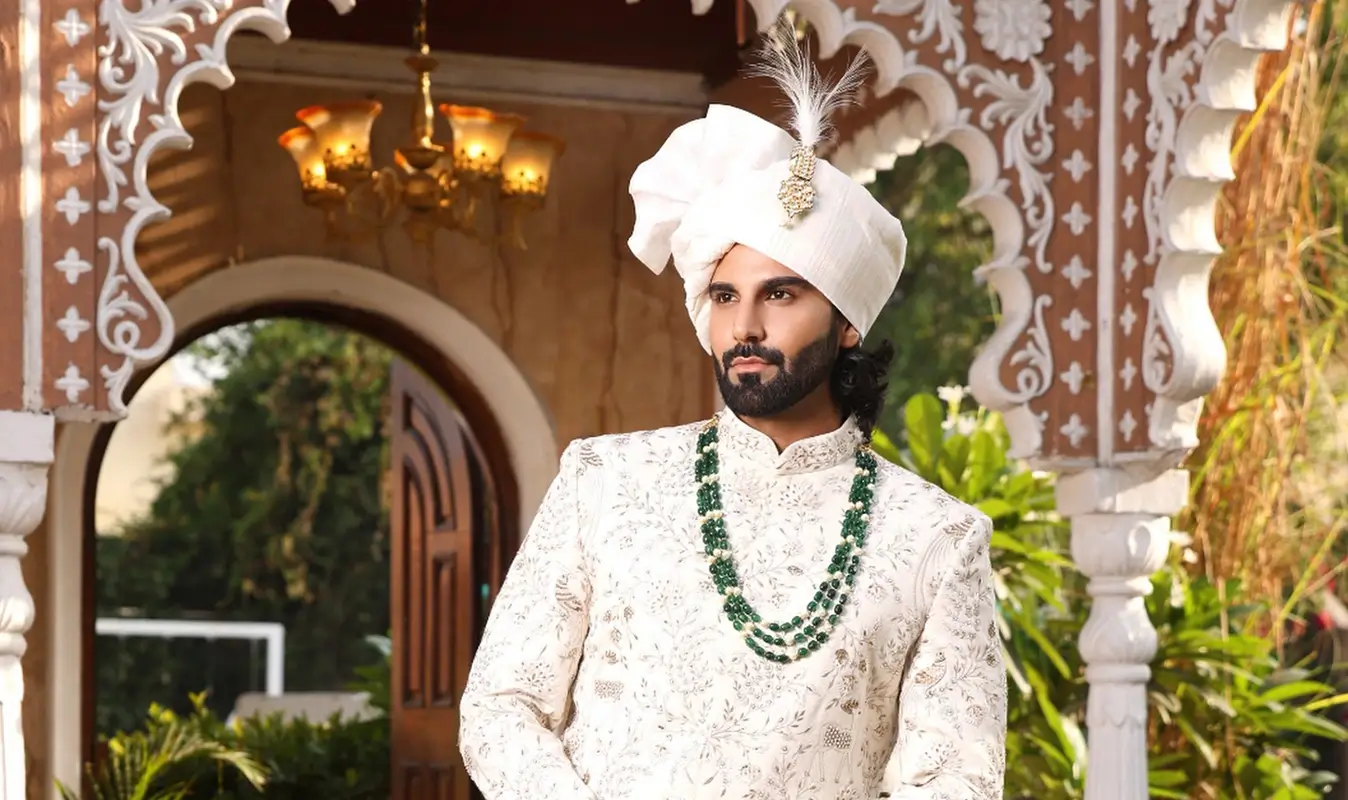
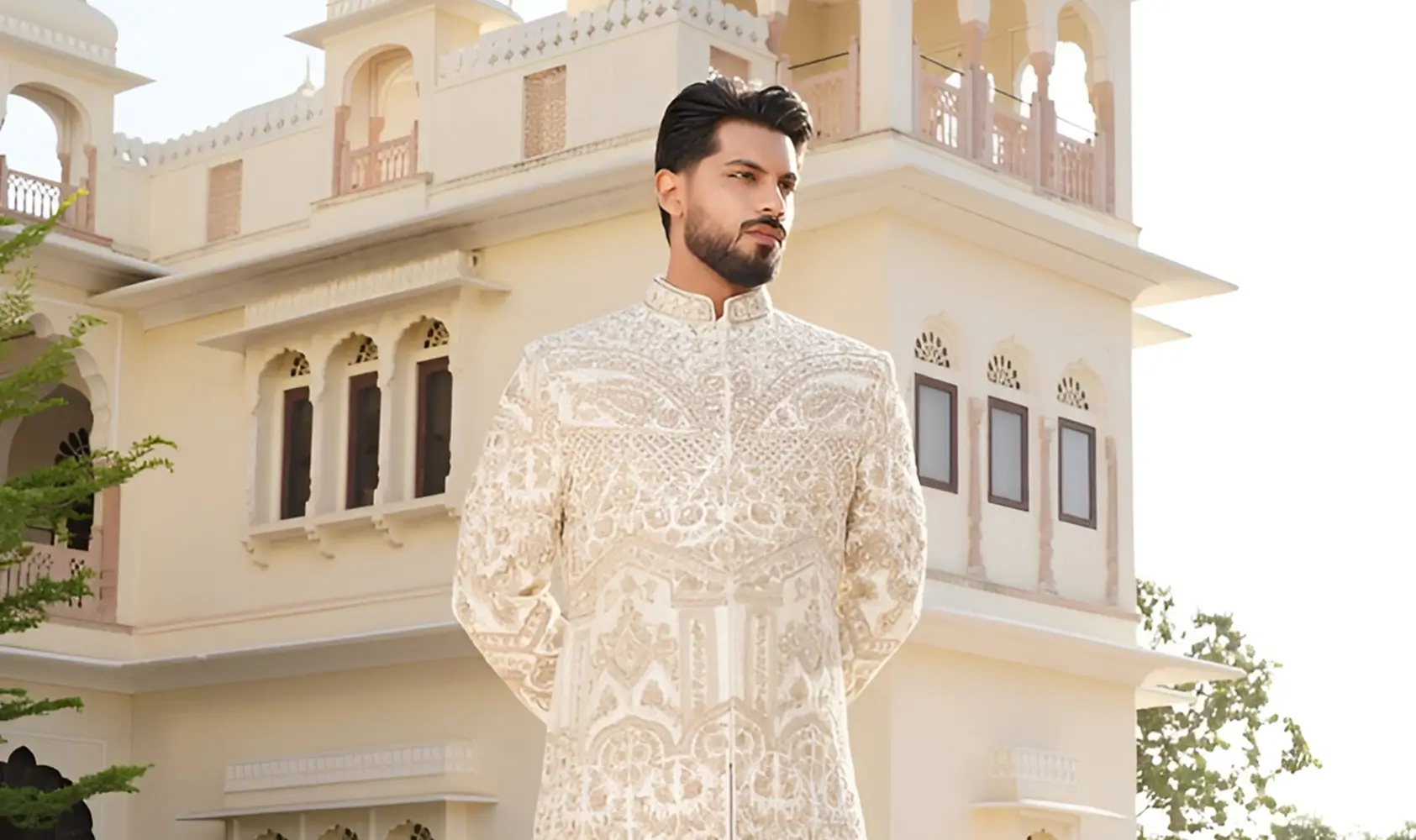
The actual wedding ceremony calls for the most formal interpretation of Indian groom dressing. A sherwani remains the gold standard — long, structured, and made from luxurious fabrics like silk, brocade, or heavy dupion. The colour palette for wedding day should be considered carefully in the context of the bride's outfit: complementary, not competing. Ivory, cream, champagne, deep red, royal blue, and regal gold are all strong choices depending on the overall aesthetic. The embroidery, the dupatta, the safa or pagdi — every detail at this level counts.
The NRI Groom's Biggest Challenges — and How to Solve Them
"I Can't Come to India for Multiple Fittings"
This is the most common concern, and it's entirely valid. Traditional bespoke tailoring requires multiple in-person fittings, which simply isn't feasible when you're based in the UK, US, Australia, or the Middle East. The solution is a design house that has built its process around remote consultations without compromising on fit or quality.
Sonam Label offers both in-store and video appointments specifically for clients who cannot visit in person. The process — from initial brief to illustrator sketches to fabric and embellishment selection — is designed to be collaborative and thorough even when conducted across a screen. Precise measurements, detailed sketches that are approved before anything is cut, and a team that communicates clearly and on schedule all matter enormously when you're coordinating from a different time zone.
"I Don't Know How to Coordinate My Family's Outfits With Mine"
Most grooms don't think about this until someone points out that a wedding with fifty family members in clashing colours creates photographs that age badly. A coordinated but not uniform approach — where the groom's immediate family is dressed in complementary tones and fabrics — makes a profound visual difference.
Sonam Label's Mittrika offering is designed for exactly this: couture wear for the groom's family and close friends, coordinated as part of the overall wedding aesthetic. Having a single design house handle the groom's outfits alongside his family's wardrobe removes the coordination problem entirely and produces results that feel considered rather than assembled.
"I Want Something That Feels Like Me, Not a Costume"
This is where bespoke design earns its value over ready-to-wear, and it's where Sonam Label's philosophy speaks most directly to what NRI grooms are actually looking for.
Sonam Brahme, the founder and designer behind Sonam Label, describes her approach in her own words: every outfit is an extension of the wearer's story. The bespoke design service starts not with fabrics or silhouettes but with a conversation — about who you are, where you live, what makes you comfortable, and what you want to feel like when you walk toward your partner on the most important day of your life. From there, the process moves through illustrator sketches, fabric selection, and embellishment choices, with the client involved at every stage.
This is not the experience of placing an online order and hoping for the best. It's a genuine creative collaboration — and for NRI grooms who want Indian wedding clothes that carry personal meaning rather than borrowed aesthetics, it's the right way to approach it.
Why Sonam Label Understands This Space Better Than Most
Sonam Label has been recognised as the Best Bridal and Groom Wear Designer of the Year — an award that reflects both the quality of the work and the breadth of the clientele served. The label has been featured on Bigg Boss 17, which brought it to a national audience well beyond its existing following among discerning wedding clients. And it is based in Pune — a city with a large and growing NRI community — which means Sonam and her team have designed for internationally-minded Indian families who understand what luxury looks like in a global context.
The label's Riwaayat offering — customised gifting and packaging for the wedding party — is a detail-oriented touch that resonates particularly with NRI weddings, where the gesture of gifting beautifully packaged, thoughtfully chosen items to outstation family members carries genuine cultural weight.
For the groom who wants every detail handled, every outfit coordinated, and every consultation available from wherever he happens to be in the world — Sonam Label is built for precisely this.
Your Wedding Deserves an Outfit as Considered as You Are
You've built a life that exists between two cultures. Your wedding should honour both — with clothing that's authentically Indian in craft and heritage, and authentically yours in silhouette, colour, and feeling.
Sonam Label is ready to design that for you, wherever you are.
Book your in-store or video appointment today — and begin the conversation that turns your wedding wardrobe from a question mark into something you'll remember for the rest of your life.
Frequently Asked Questions
1. How far in advance should an NRI groom start the outfit consultation?
Ideally six to eight months before the wedding date, particularly if multiple functions and family coordination are involved. Bespoke pieces require time for sketching, fabric sourcing, embroidery, and fittings — starting early removes deadline pressure entirely and allows for revisions without stress.
2. Can Sonam Label create coordinated outfits for the groom, his family, and the groomsmen?
Yes — Sonam Label's Mittrika collection is designed for exactly this: couture wear for close family and friends, coordinated with the groom's wardrobe as a unified aesthetic. One consultation, one design vision, one point of contact.
3. Does Sonam Label offer video consultations for NRI clients who cannot visit in person?
Yes. Sonam Label explicitly offers both in-store and video appointments to accommodate clients based internationally. The full bespoke design process — from initial brief through fabric and embellishment approval — can be conducted remotely.
4. What is the typical price range for a bespoke groom's outfit from Sonam Label?
As a luxury and bespoke label, pricing depends on the complexity of embroidery, fabric selection, and number of pieces. The best approach is to book a consultation where your requirements and budget are discussed directly with the design team.
5. Can Sonam Label handle wedding gifting as well as outfits?
Yes — the Riwaayat offering covers customised gifting and packaging, which can be coordinated alongside the bridal and groom wardrobe as part of the overall wedding experience.
6. What makes Sonam Label one of the best wedding dress designers in India for NRI clients specifically?
Three things: the availability of video consultations that make the bespoke process accessible from abroad, the Mittrika family wardrobe coordination offering that solves the most common NRI wedding style challenge, and a design philosophy that starts with the person — not a template — so the result feels genuinely personal rather than borrowed.